Literature review AI that turns your papers into a cited review chapter
Bring the papers you've found, or search 8 academic databases. Compare them side by side, find the themes and gaps, then draft your literature review with in-text citations from your own library.
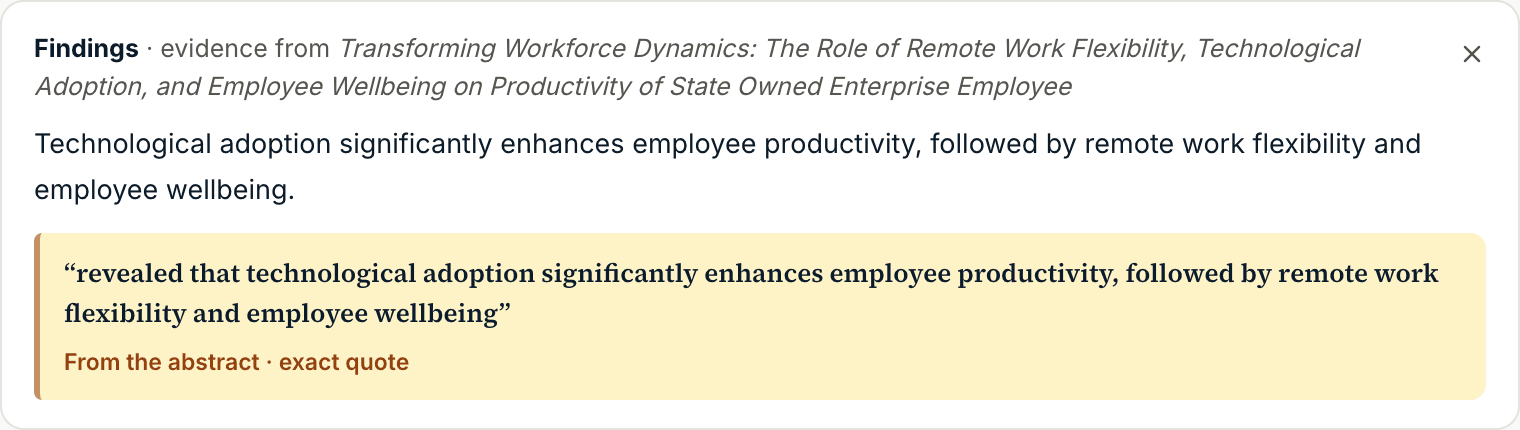
 Every cell links to its quote
From a pile of papers to a literature review chapter
A good literature review compares and connects studies. It doesn't summarize them one by one. Each step below builds on the one before.
- 1Collect your papersImport from Zotero, Mendeley, BibTeX, RIS or EndNote, add DOIs, upload PDFs, or search Crossref, OpenAlex, Semantic Scholar, arXiv, Europe PMC, CORE, DOAJ and OpenAIRE.
- 2Build the evidence tableEach paper's research question, method, sample, findings and limitations, side by side, with links to the passages they came from.
- 3Find themes and gapsGroup papers into themes, then see research directions: research gaps framed as open questions, with a possible method and the evidence still missing.
- 4Draft the review chapterWrite your literature review from the sources in your project, with in-text citations and a reference list in your style.
- 5Check every referenceEach reference is matched to its DOI record. Anything that can't be matched is flagged for you.
A literature review matrix, built for you
Also called a synthesis matrix. Every paper gets a row: research question, method, sample, findings and limitations. Each cell links to the passage it came from, so you can check it. Edit any cell or add rows by hand.
Exact words, straight from the paper Each theme names its sources
See the themes across your sources
Papers are grouped into themes, each with a short summary and the list of papers behind it. Use them to structure your review by idea, not by author.
Spot gaps worth researching
Research directions suggest open questions from your library. Each one comes with what it would add, a possible method, how feasible it is, the evidence still missing and a starting outline.
 Clear about what is only a proposal
 Every sentence tied to a passage
Ask questions, get answers from your own papers
"Which studies used longitudinal data?" Answers cite your sources. If your library has no evidence for an answer, it tells you instead of guessing.
Draft the review in your thesis, not in a separate tool
Your literature review is written inside your thesis project, next to your introduction and methodology. Citations use your chosen style (APA 7, Harvard, MLA, Chicago, IEEE or Vancouver) and every reference is checked against its DOI record.
 Cited from your own library
Keep searching where you like. Write here.
Many students find papers with dedicated search tools or their library database, and keep them in Zotero or Mendeley. AI Thesis Writer picks up from there: import your Zotero or Mendeley library, or a BibTeX, RIS or EndNote export, and duplicates are merged automatically.
AI can speed up a literature review. It can't replace your judgement.
Try it free on 10 papers
| Limit | Free | Essentials | Plus | Pro |
|---|---|---|---|---|
| Literature reviews drafted | 1 sample section, up to 10 papers | 1 a month | 2 a month | 4 a month |
| Sources in your library | 10 | 75 | 150 | 500 |
| Price | $0 | $12/mo | $19/mo | $29/mo |
A literature review counts when you draft your literature review chapter. Building the evidence table and themes doesn't use it. A single project holds up to 100 sources.
See plans and pricingLiterature review questions, answered
What is a literature review?
A literature review sums up and compares what published research already says about your topic. It shows the main themes, where studies agree or disagree, and the gap your own research fills.
Is it okay to use AI for a literature review?
Many universities allow AI help for finding, organizing and summarizing papers, as long as you check the results and disclose AI use. Rules vary, so check your course's policy. AI Thesis Writer logs AI use and creates a disclosure statement.
Can ChatGPT write a literature review?
It can write text that sounds like one, but general chatbots can invent ("hallucinate") sources or cite them inaccurately. AI Thesis Writer works only from papers in your library and checks each reference against its DOI record.
What is a literature review matrix?
A table with one row per paper and columns such as research question, method, sample, findings and limitations. It makes studies easy to compare. AI Thesis Writer builds one from your papers, and you can edit every cell.
Can I use papers I've already collected?
Yes. Import from Zotero, Mendeley, BibTeX, RIS or EndNote, add papers by DOI, or upload PDFs. You can also search 8 academic databases from inside your project.
Can it do a systematic review?
Not yet. AI Thesis Writer doesn't run PRISMA screening or formal data extraction, so it isn't built for systematic or scoping reviews. It's built for the narrative literature review chapter of a thesis or dissertation.
How many papers can one review use?
The free literature review sample uses up to 10 papers. On paid plans, a review can use every source in your project: up to 100 per project, within your plan's library size.